Follow the map — the marker updates while I move through the city.
Sonic Outpost is a mobile studio: live improvised ambient electronics, played on the streets and among friends. No laptop, no backing tracks, no second takes — every set is built from nothing in the moment, loops and drones and rhythms layered on compact hardware and shaped by the place it lands in. The outpost moves; the map above shows where and when it plays next.
Behind the project is Jeroen van Vliet, a multi-instrumentalist from Utrecht whose productions run from ambient, downtempo chill, dub and techno to deep house, DNB, hiphop, funk, jazz and reggae. The music started early: at five he was already mixing and splicing tape on his father's Revox decks. By his early teens he was DJ-ing, saving up for a drive-in show of his own and playing it at school parties — and in his twenties in clubs around Amersfoort, playing acid house with two turntables and a strobe. Learning piano, percussion and melodica ran alongside it — all of it self-taught, in the hours around a career as a software engineer. Much later, in 2014–15, he ran a series of Sunday-afternoon listening concerts for Kytopia in the old Tivoli on the Oudegracht, Utrecht's pop temple.
He has always played on his own terms, and the engineering turned out to be exactly the skill he needed to build his own instruments: simple single-oscillator synths and hardware controllers, made from scratch. From there came the experiments: interfaces for talking to plants and other organisms in a musical way, algorithms for randomness and chaos, music that generates itself.
Sonic Outpost itself took shape in 2023, developed in his studio and designed to leave it: small enough to carry, built for dawless jamming, battery powered throughout — at least eight hours of playing with no outlet in sight.
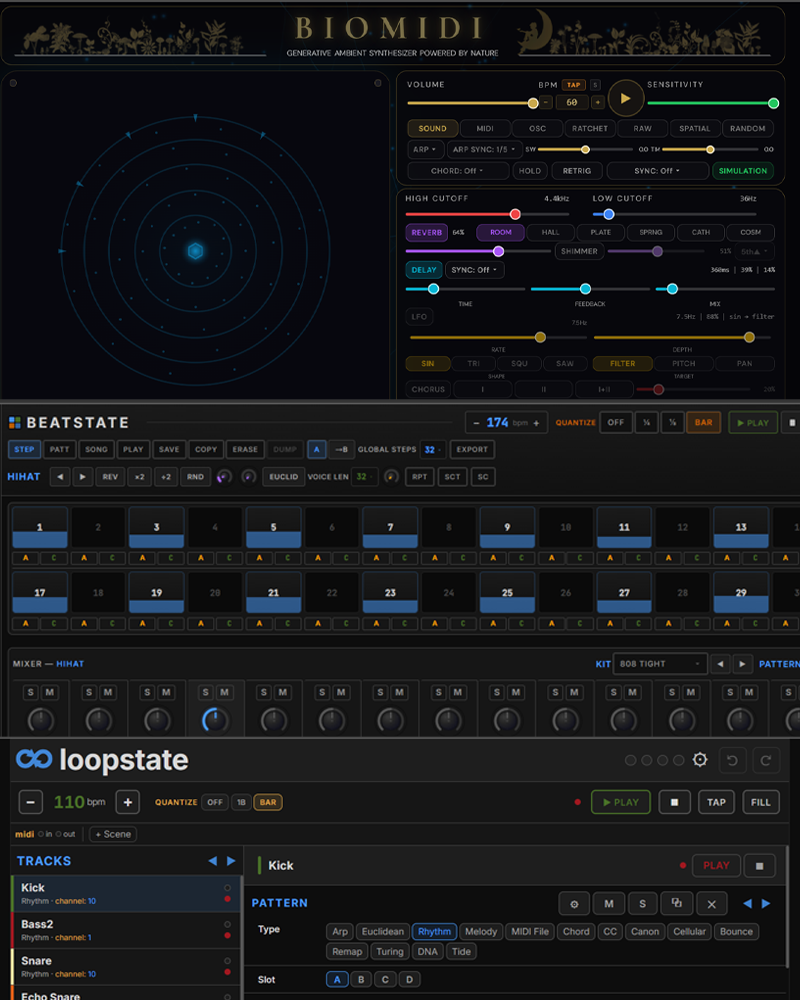
Besides the hardware, Jeroen also developed three software instruments, free for anyone to use in a browser. The applications are not only instruments but also very extensive educational projects (see the manuals for BioMidi, BeatState and LoopState). Partly with classrooms in mind: no budget for instruments, plugins, licences or theory books, and a browser is enough to start making and learning music.
“Expect the unexpected.” Randomness isn't a side effect here, it's the material — whether that's a plant's electrical signal shaping a melody or a set assembling itself on a street corner, the interesting part is the part nobody planned.
The full outpost — compact hardware only, everything battery-powered, everything on the table.
All Roland units are modified with bigger internal batteries — good for over 8 hours of continuous play, far from any power outlet.
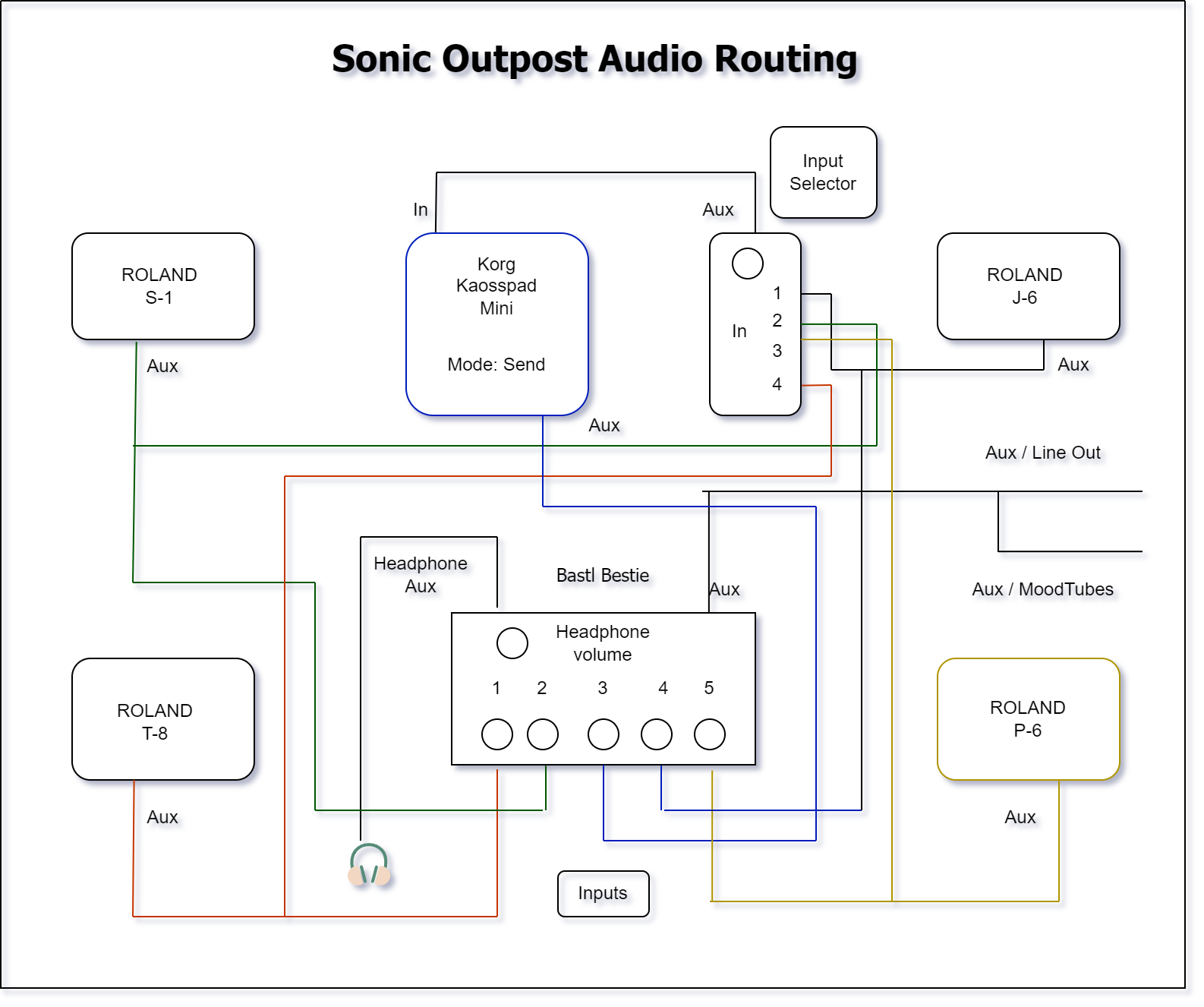
Recordings from the street sessions — improvised, unedited, one take.
Collaborations, questions, or just want to know where the outpost lands next.